Which Printing Technique Was Popularized in Poster Art in the Mid19th Century
March 14, 2017
The Broadside
The history of the poster starts with blackness-and-white broadsides in the 1600s, which evolved in the wake of the printing press. These one-sided sheets of paper were a quick way to mass-distribute information. Shopkeepers propped production announcements in their windows; governments called people to action in the issue of war; public decrees were quickly distributed. A wanted poster of the old American West would be a archetype example of a broadside. The Declaration of Independence is also a famous example; printed as a broadside, news of the victorious revolution spread chop-chop throughout the American colonies.
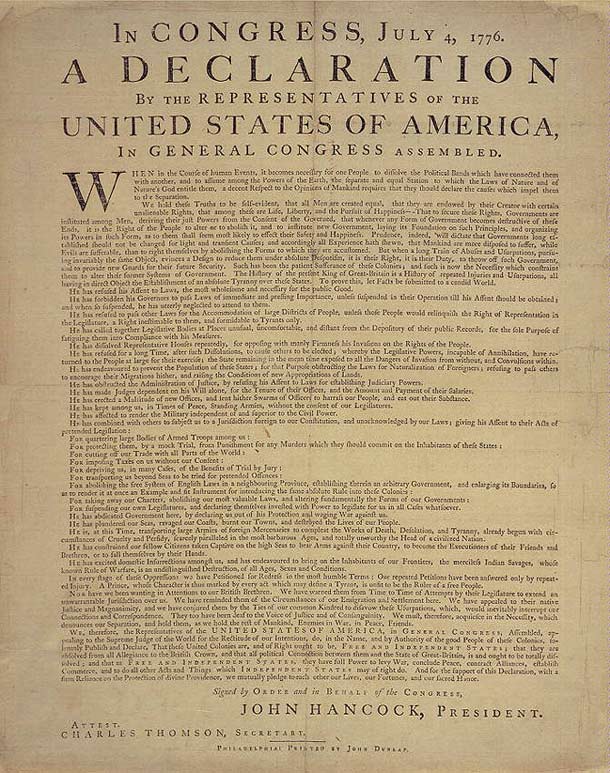
The first 150-200 copies of the Announcement of Independence were broadsides, printed by John Dunlap of Philadelphia on July iv, 1776.
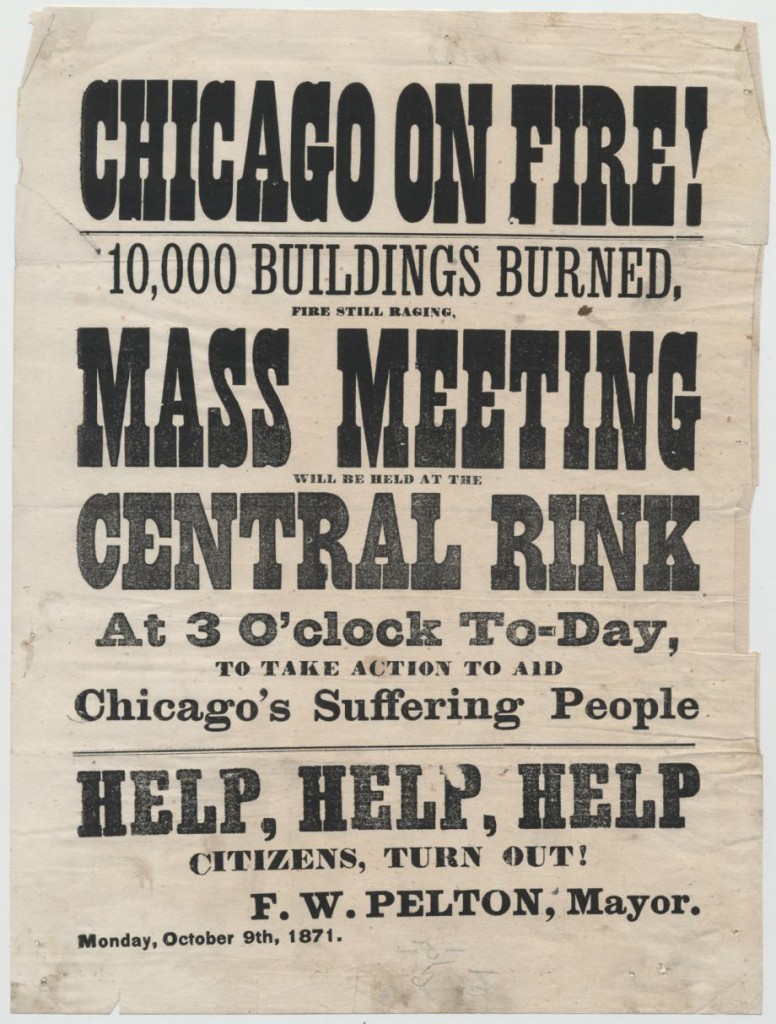
This broadside announced a coming together to take activity against the Neat Chicago Fire on October 9, 1871. Image via the Chicago History Museum.
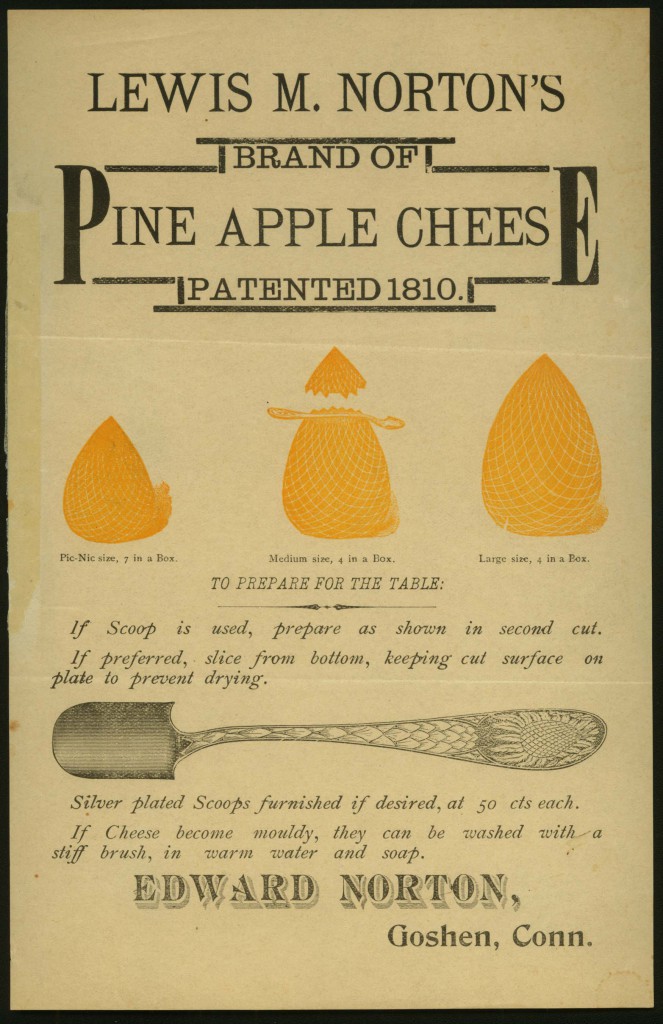
A broadside from the 1800s, showing addition of a single color and illustrations to highlight the informational text.
A Turning Bespeak
Broadsides were an ephemeral form—hands printed, distributed for quick impact, read for the data they contained, and then tossed abroad. But as time passed and technology advanced, the broadside evolved. Typefaces got a little more interesting—larger, more decorative. Images were added to grab a viewer's attention.
And then a turning point came in the 19th century in Paris. The poster transcended its role every bit attending-getting carrier of applied information. It became beautiful. It became desirable. Information technology transformed the grayness urban commute into a pleasurable stroll punctuated by cheerful color. Information technology became the passion of a group of aficionados who avidly collected these posters, preserving them from the brusque life bicycle of ephemera. In short, the poster became art.
So how did it happen?
There are a number of factors: the rise of the eye class in Paris with more expendable income for collecting, advances in engineering science that allowed for larger and more than complex poster designs, a multicultural milieu with artists of all types mingling and sharing ideas in Paris's maverick neighborhoods, a city redesign that included street piece of furniture designed specifically for posters, and more.
Simply i of the central factors is the reinvention of lithography, the procedure past which many posters were made before they became fine art.
And Jules Chéret is the one who reinvented information technology. Chéret is widely known as the male parent of the modern poster, and it is in his footsteps that the remainder of the major artists in the Driehaus Museum exhibition, Fifty'Affichomania: The Passion for French Posters, followed.
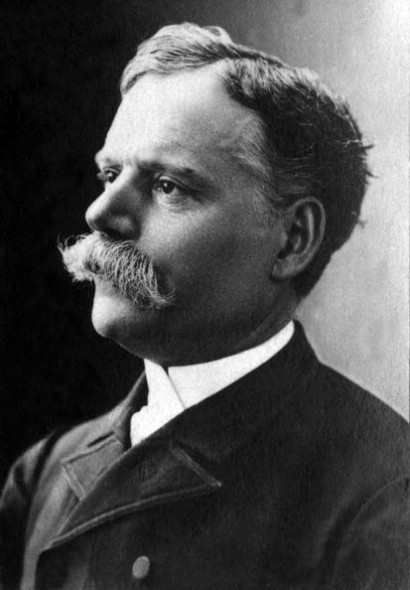
Jules Chéret (French, 1836 – 1932)
Jules Chéret
Chéret was born in 1836, the son of a French typesetter in Paris. He briefly studied drawing, then started training at age 13 in lithography, working as an apprentice and journeyman in Paris and London for 17 years. He got his break when perfume manufacturer Eugène Rimmel hired him equally a designer. Soon after he started his ain lithographic printing firm in Paris, firmly believing that lithography would shortly supplant his father's letterpress industry as the premier printing technique.

Carte du jour for Eugène Rimmel, designed past Jules Chéret.
Jules Chéret's outset major poster committee was this one for Jacques Offenbach for his 1858 production of "Orpheus in the Underworld."
Lithography
Lithography wasn't new. It was invented in 1798 past a Bavarian actor and playwright, Alois Senefelder, to reproduce his scripts. Senefelder's printing process is simple to empathise if you keep in mind that oil and water don't mix. To make a lithograph, you take a greasy or waxy crayon and draw images or words onto a big, smooth limestone surface. Then you douse the surface of the stone in water and ringlet it with ink. The greasy drawing repels the h2o and soaks upward the ink, while the wet areas without any drawing repel the ink. And so when you lot printing the rock—with considerable force—onto a piece of paper, it transfers the inky images and text onto that paper.
If you lot wanted a color lithograph, too called a chromolithograph, things got a piffling more than complicated. You had to prepare as many stones as you want colors. Information technology was laborious and the stones were incredibly heavy, so lithographs remained pretty much monochromatic well into the 1860s. If color was utilized at all, information technology was a lilliputian splash every bit a highlight to the heavily crammed text, and not a core part of the visual design.
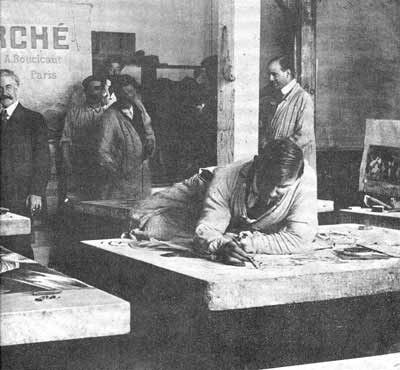
An artist cartoon on a lithographic stone.
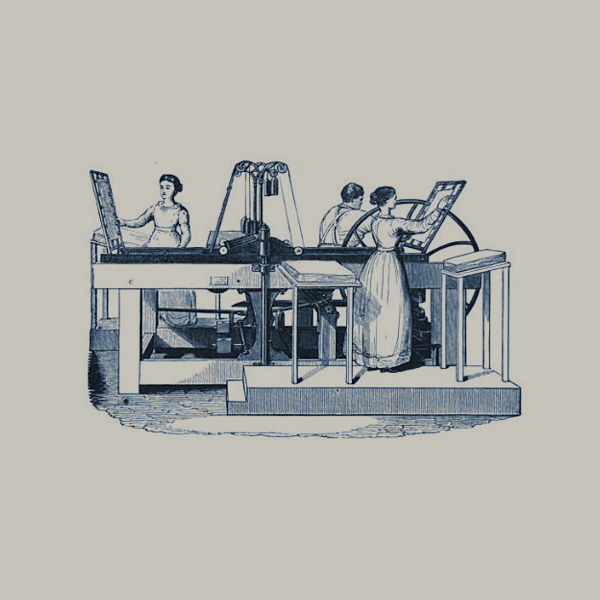
Illustration of printing a lithograph. Image via DesignHistory.org.
The Artistic Poster
Given the lack of design consideration, low quality, and disposability of earlier commercial lithographs, lithography got a reputation as an unworthy artistic medium. To say that you were making lithographic art in the 19th century would exist like printing a total-page advert in a sleeky beauty mag today and calling it your called artistic medium. It isn't incommunicable. It would just exist difficult for many to imagine elevating this medium we associate with makeup advertisements to the realm of museum collections. It was the same with lithography. It suffered from its association with quick and commercial information. At that place was nothing daring, original, or beautiful about lithography.
That is, until Jules Chéret. Visionary artists often have an idea or grade that already exists and transform it so completely that information technology appears new and original. This was the case with Chéret, who appeared unconstrained by the negative associations with lithography and decided to utilize it for colorful, cheerful, and vivaciously French artworks. In 1884 Chéret organized the first group affiche exhibition in art history, ushering in an era of these images being accepted—and enthusiastically celebrated—as fine art, and in 1886 he published the first book on poster art. Chéret would also somewhen work with printing houses that catered to collectors who wanted poster fine art for their own.
Chéret made advances to lithography in the mid-19th century that others would soon imitate. He designed his ain lettering, taking advantage of the fact that the lithograph, as opposed to the printing printing, allows for the creative person to draw freehand on the stone's surface. The text therefore became a role of the poster's overall design. Chéret likewise reduced the amount of text, leaning heavily on the image to communicate near a production or event. He also simplified the chromolithographic process by using 3 primary colors: three stones inked with ruddy, yellowish, and bluish. By making these colors semi-transparent, he could layer them and create dissimilar shades. Finally, Chéret approached the limestone in a painterly way, using blithe brush lines, crosshatch, stipple, soft watercolor-like washes, and areas of flat color. A young man chromolithographer, André Mellerio, heralded this fine art of the street, calling the new colour affiche "the distinctive art of our time."
Chéret's creative advances transformed the world of advertising. His posters featured cheerful, lightly clad, ofttimes eight-feet alpine beauties who became known as Chérettes. Chéret's women were inspired by the well-heeled, garden-party women of Rococo paintings, a glorious age in France immortalized by artists like Jean-Honoré Fragonard and Jean-Antoine Watteau. These attracting women showcased the pleasures of Paris to tantalizing effect, including music halls, theatres, performers, beverages, medicines, and lamp oil.
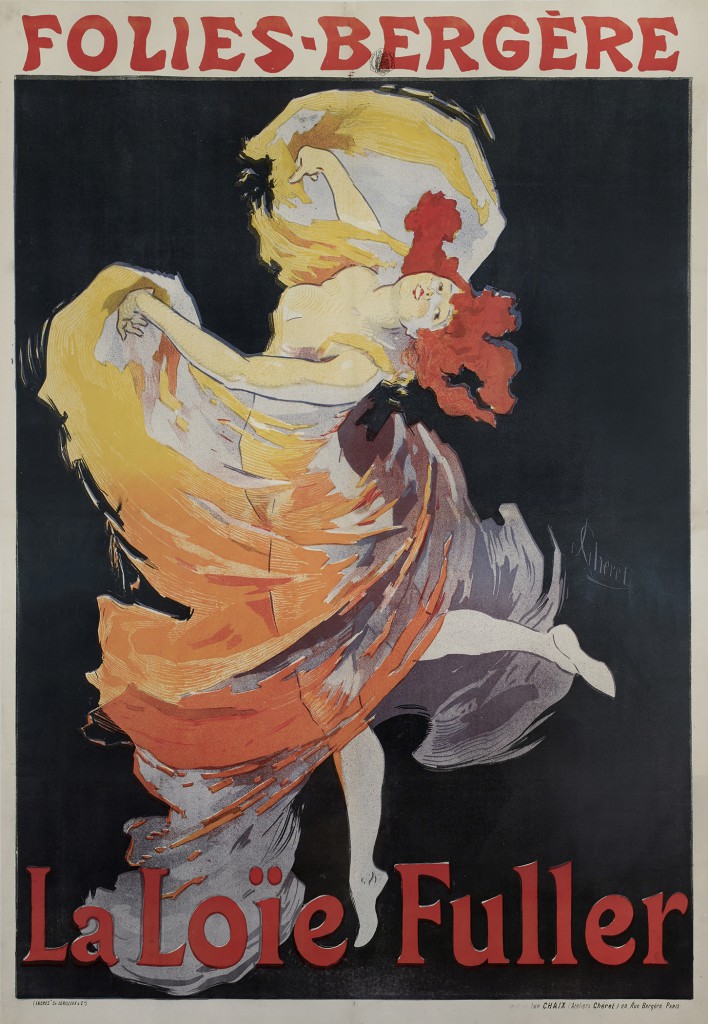 Folies-Bergère: La Loïe Fuller, 1893.
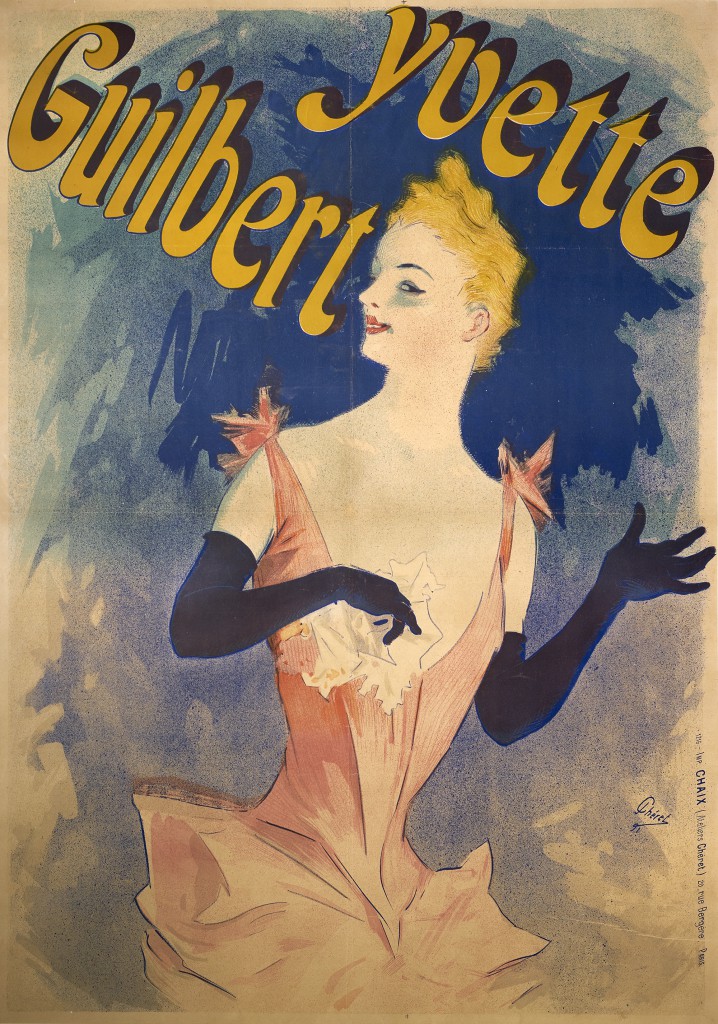 Yvette Guilbert: Au Concert Parisien, 1891.
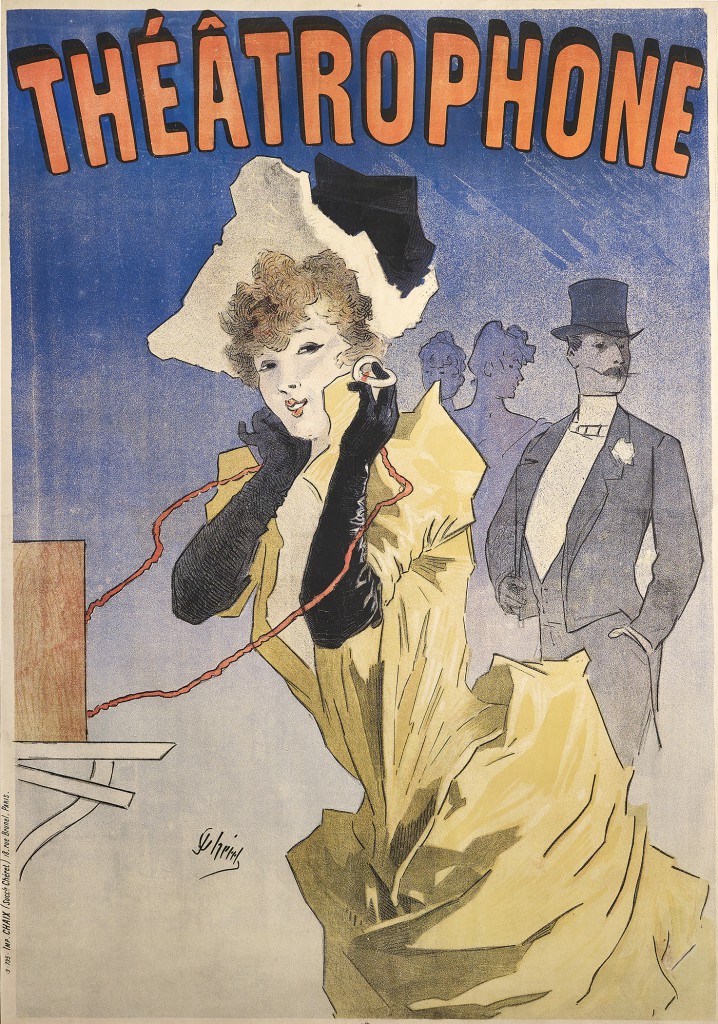 Théâtrophone, 1890.
Chéret was recognized in his own time equally 'the king of the poster'. One art critic remarked that "there was a thousand times more talent in the smallest of Chéret's posters than in the bulk of the pictures on the walls of the Paris Salon." He was ofttimes imitated, and an entire generation of artists would follow and build on his work. Ane of them was Henri de Toulouse-Lautrec. To acknowledge his debt to the older creative person, Lautrec sent Chéret a copy of every poster he produced.
After creating more than a g posters in Paris, Chéret retired to Dainty in the south of French republic, where a museum was established in his accolade in 1928, 4 years earlier the creative person died at the historic period of 96. The Musée des Beaux-Arts Des Nice, as it'south called today, however stands every bit a testament to the creative person's transformation of the earth of fine art.
Resources
Eskilson, Stephen. Graphic Blueprint: A New History
Encyclopaedia Britannica, "Jules Cheret." Updated July 21, 2009.
Graphic Design History's "History of Posters" series
Hamilton, Sarah Elizabeth. From Publicity to Intimacy: The Poster in Fin-de-siecle Paris
Ives, Colta. "Lithography in the Nineteenth Century," Heilbrunn Timeline of Art History, The Metropolitan The L'Affichomania: The Passion for French Posters, essay by Jeannine Falino. The Richard H. Driehaus Museum. The Monacelli Press, New York, 2017.
Museum of Modern Art, gallery labels on works by Jules Chéret (moma.org/collection)
Museum of Art. October 2004.
"A Brief History of Broadsides," Tavistock Books

Post a Comment for "Which Printing Technique Was Popularized in Poster Art in the Mid19th Century"