Babies Are Typically Able to Walk by Supporting Themselves at Around ______ Months of Age
© 2019 GWEN DEWAR, PH.D., ALL RIGHTS RESERVED
 opens Paradigm file
Motor milestones mark heady transitions in a baby's life, just there is no single, universal schedule that all babies follow.
For example, by six weeks, near babies can elevator up their heads while they lie on their stomachs.
By iii months, about babies can also lift up their chests, using their arms for support.
By 4 to 5 months, the average babe tin coil over, from back to tum (Nelson et al 2004).
Only the exact timing varies. Some babies take learned to roll over by two months! And the same is true for other motor milestones.
For example, studies suggest that more than than 50% of infants tin
- sit down upwardly, unsupported, by 6 months,
- crawl on hands and knees past 8 and a half months,
- stand up, unassisted, by ten and a half months, and
- walk, unassisted, by 12 months.
Yet many babies reach these milestones months earlier – or months subsequently.
To know if your baby is on track, you need to know about the range of what'southward normal.
What'southward the earliest y'all might await your infant to walk?
If your baby is slow, when should you be concerned about the possibility of a developmental delay?
And can parents practise to support healthy development?
Equally we'll come across, a baby'south environs — and personal quirks — affect the timing of motor milestones. Babies develop skills faster when we encourage them to practise opportunities to practice.
Here is an overview of babe motor milestones, including the development of gross motor skills and fine motor skills. Throughout, I notation ways in which parents can influence development, and terminate with some evidence-based tips.
Gross motor milestones

Gross motor skills involve the big muscles of the legs, body, and arms. And when information technology comes to babies, pediatricians and developmental scientists are especially focused on half dozen of these skills:
- sitting upward without support
- crawling
- standing with assist
- walking with assist
- standing without back up
- walking without support
When tin can you expect your infant to reach these motor milestones?
Every infant is dissimilar.
Some infants can sit down up, unaided, by the historic period of iv months. More than than half of all babies have figured this out by 6 months. And about 10% of infants don't attain this particular milestone until they are vii.5 months or older.
Other motor milestones present an even wider range of timing. For instance, while the median historic period for learning to walk (unaided) is about 12 months, a few babies hit this milestone before the age of 9 months, and approximately ten% of babies don't begin walking without support until they are more than 14.v months old.
So if someone ever tries to sell yous a chart of baby development "month past month," run the other way. That'due south simply not how it works.
A better way to visualize the evolution of motor skills is to recall in terms of developmental windows – fourth dimension periods during which approximately 98% of babies can be expected to achieve a given milestone. Here'due south an infographic I made to illustrate – -adapted from a figure published past the World Health Organization (WHO 2006b).
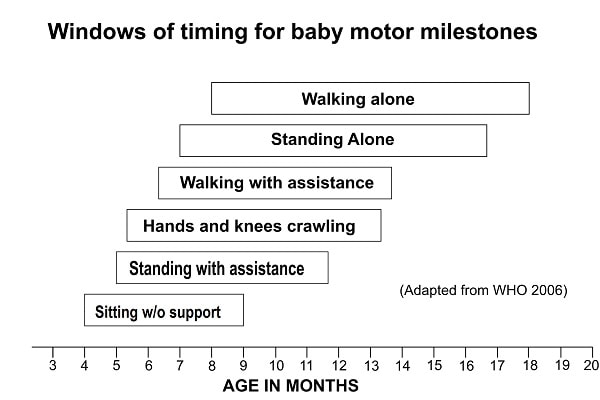
As y'all can see, some gross motor milestones tend to occur earlier than others, but the windows are wide, and they overlap each other. The resulting picture doesn't predict when your baby will hit whatsoever detail milestone – not in whatsoever fine-grained sense. But it provides united states with a realistic time range.
If a babe'southward evolution seems wearisome, when should you exist concerned?
First, trust your intuitions. If, for any reason, you realize that you are concerned – whether or non you lot think you "should" be – talk to your pediatrician. If it turns out that your infant is having problems, early intervention can brand a big difference.
Second, if you're wondering most cutoff dates for achieving a given milestone, proceed in mind: Information technology depends. Information technology depends on what other signs your baby is showing, and whether your baby has whatsoever known risk factors for a developmental trouble.
But in the absence of any other concerns, a skilful rule of thumb is to pay attending to the 90th percentile – the age by which 90% of babies have achieved a given milestone (Sice 2007).
If your baby hasn't reached a milestone by this date, consult with your pediatrician. Being slower doesn't mean that your child has a developmental delay. But it's a sign that your baby's progress should be reviewed and monitored.
The previous chart doesn't provide data well-nigh percentiles, so I'thou going to add information technology hither:

What virtually the order of motor milestones? Is in that location something incorrect if a babe seems to skip a step, or experiences a reversal?
Not necessarily. Babies don't always hit these milestones in the same gild, and 1 of the milestones – itch – isn't fifty-fifty universal.
If you look at our graphics, y'all might reasonably assume that your baby will hit gross motor milestones in the following sequence:
(one) sitting up without support; (two) crawling on hands and knees; (three) standing with aid; (4) walking with assistance; (5) standing without back up; and (6) walking without support.
And indeed, when the World Health Organization (WHO) tracked the development of babies in 5 countries (Republic of ghana, Republic of india, Norway, Sultanate of oman and the The states), this pattern was constitute in the largest pct of infants – most 42% of them.
But more than than a third of the babies achieved milestone #3 (standing with aid) before they crawled. Almost nine% of the babies likewise striking milestone #4 (walking with assistance) before crawling.
Another 10% of babies mixed the order up in even more exotic ways, and approximately 4% of babies never crawled on their easily and knees (WHO 2006a).
Other studies have reported even college rates of babies who never crawled — babies who were healthy and went on to walk within the normal fourth dimension window.
And then there isn't a main sequence of motor development milestones that all babies follow. As motor development experts Karen Adolph and John Franchak (2016) explain:
"The milestone charts advise an orderly, historic period-related march through a serial of stages, but developmental pathways can differ and individual infants exercise non strictly adhere to the normative sequence derived from boilerplate onset ages. Infants tin can acquire skills in various orders, skip stages, and revert to earlier forms."
Why is at that place so much variation?
Some of it is cultural.
For example, in some African countries, parents actively railroad train their babies to sit down, stand up, and walk. They provide infants with lots of do, and this appears to advance the development of upright posture (Super 1976; Bril and Sabatier 1986; Karasik et al 2015; Adolph and Robinson 2015).
The notion is supported by experimental work.
Newborn babies have a "stepping reflex": If you hold a infant so that soles of his feet brush confronting the ground, the baby will spontaneously take steps — long before the baby is capable of continuing under his own weight.
The reflex usually disappears over time, but not if babies are given daily opportunities to practice the action, and such babies have reached the milestone of walking (without assistance) at an before age (Zelazo 1983).
So we've got evidence that parenting practices can speed up the pace of motor evolution. And the converse is too true: Parenting can slow it down.
In places where parents adopt a hands-off approach – or actively prevent babies from moving around during the day – infants take longer to achieve sure motor milestones (WHO 2006b; Mei 1994; Adolph and Robinson 2015; Adolf et al 2018).
What about itch? Ecology factors play a big office at that place, likewise.
In places like the United states of america, parents await babies to clamber, and they provide them with opportunities to do so. Only this isn't true everywhere, and information technology probably wasn't truthful for our hunter-gatherer ancestors.
Crawling outdoors – in a world inhabited by predators – wouldn't have been a skilful idea, and indeed, contemporary hunter-gatherers don't encourage their infants to crawl.
Every bit I explain in this guide to the opens in a new windowdevelopment of crawling, it's not unusual for babies to reject hands-and-knees crawling in favor of other methods of getting around – like scooting around on their bottoms, or rolling from place to place.
And it'south articulate that motor milestones are influenced by genetics.
When researchers accept controlled for the effects of culture and parenting, they've found that genetic factors have an important bear on on the timing of motor milestones (Smith et al 2017).
Siblings don't reach motor milestones at exactly the aforementioned time, even if they are raised under like weather condition. Private differences in temperament, body fat limerick, and other characteristics — characteristics influenced by genes — can touch on a baby'southward action patterns, leading some babies to spend more time practicing developing motor skills.
What about other motor milestones?
Belongings objects
Two-month-old babies can hold onto small objects – if we place these objects directly into their easily. And they are likely to bring the items up to their mouths to investigate (Rochat 1989).
Simply the grasp of a immature infant isn't very secure or reliable. When babies arms flail around, they are likely to lose their grip on any they are holding.
Learning to reach for – and firmly grasp – objects

Betwixt the ages of four and vi months, most babies will have developed the manual dexterity to hold onto and shake a toy. They are likewise developing the ability to movement an objects back and along between easily.
Babies tin successfully reach for a stationary object, but their movements are jerky, and babies aren't withal good at catching a moving object. Babies don't withal understand how to grasp big objects efficiently – they don't show a preference for doing information technology with both hands.
Between half-dozen and 9 months, these skills ameliorate considerably. Babies become proficient at communicable hold of moving objects. For instance, they can take hold of rolling assurance, and guess when some balls are rolling too fast to grab (van Hof et al 2008). By eleven months, babies also show better planning for picking up big objects – they consistently reach with both easily at once (Fagard and Jacquet 1996).
Fine motor control and tool use

By 8 to ten months, most babies can show off fine motor skills. They are developing the power to grasp small objects between the thumb and alphabetize finger. Babies are unremarkably able to drink from a cup, and they are figuring out how to eat with a spoon.
But their attempts are awkward. If you lot provide them with a loaded spoon, they are likely to option it upwardly by the bowl end – not the handle (McCarty et al 2001; van Roon et al 2003). Moreover, they will hold onto the spoon with a fist grip, not a precision (thumb-to-index figure) grip.
By xiv months babies are more than adept. They might still concur the spoon in a fist grip, but they've learned how to hold it past the handle (van Roon et al 2003).
And around this time – from 12 months onward – babies can use writing implements to draw random-looking marks and dots.
By eighteen months, these efforts may go more controlled and organized, and may include directly lines and zig-zags (Dunst and Gorman 2009). More than complex drawings – of geometric shapes, and figures with identifiable features (like a blob animal with legs) – develop slowly, and may non appear until a child is 3 years sometime (Dunst and Gorman 2009).
Give your baby lots of "tummy time."
Equally I note in this commodity, it's clear that "tummy fourth dimension" is important. Babies develop improve muscle command when they spend supervised time on their stomachs. It'south good for edifice cervix strength, and it helps babies develop the ability to roll, crawl, and sit down up from a lying position (Kuo et al 2008).
Assist babies practice an upright posture.
We've also seen how parents can back up the development of sitting and standing. Do sessions – where you help your baby prefer an upright posture by providing support with your hands – may speed up development.
Help babies attain and grasp.
Not surprisingly, babies acquire faster when we provide them with opportunities to touch, hold, and achieve for objects.
For instance, in experiments using mittens and toys covered in Velcro®, babies as young as 3 months have gotten extra practise handling objects that would usually exist difficult to grasp. When parents encourage their babies to explore objects with such "pasty mittens," babies accept shown long-term developmental benefits (Needham et al 2017; Libertus et al 2015).
Permit babies bang.
Information technology'south noisy and obnoxious, only researchers remember that babies develop of import motor skills when they take hold of onto an object and blindside away (Kahrs et al 2012). Just make sure the object is safe for your baby to use!
Encourage free play – and make yourself a visible, responsive, and non-bossy playmate.
Babies exercise more – and spend more than time interacting with objects – when we provide them with the time and space to appoint in free play (Adolf and Koch 2019). And babies do good when nosotros go down on the floor to collaborate with them.
More than reading
For more information about infant development, see this opens in a new windowindex to Parenting Science manufactures.
References: Motor milestones
Adolph K. 2008. Motor and concrete development: Locomotion. In M.M. Haith and J.B. Benson (Eds), Encyclopedia of infant and early on childhood development, M.M. Haith and J.B. Benson (Eds), San Diego: Academic Printing, pp. 359-373.
Adolph KE and Robinson SR 2015. Motor development. In R. M. Lerner (Series Eds.) and L. Liben and U. Muller (Eds), Handbook of kid psychology and developmental science: Vol. ii: Cognitive processes (7th ed.) New York: Wiley, pp. 114-157
Adolph KE and Hoch JE 2019. Motor evolution: Embodied, embedded, enculturated, and enabling. Almanac Review of Psychology, 70, 141-164.
Adolph KE, Hoch JE, Cole WG. 2018. Evolution (of Walking): fifteen Suggestions. Trends Cogn Sci. 22(viii):699-711.
Bril B, Sabatier C. The cultural context of motor development: Postural manipulations in the daily life of Bambara babies (Mali) International Journal of Behavioral Development. 1986;9:439–453.
Dunst C., Gorman Eastward. (2009). Development of infant and toddler mark making and scribbling. Cent. Early Larn. Lit. Rev. 2, one–16.
Fagard J, Jacquet AY. Changes in reaching and grasping objects of different sizes between 7 and 13 months of age. British Journal of Developmental Psychology. 1996;14:65–78.
Kahrs BA, Jung WP, Lockman JJ. 2012. What is the role of infant banging in the evolution of tool apply? Exp Brain Res. 218(2):315-20.
Kuo YL, Liao HF, Chen PC, Hsieh WS, Hwang AW. 2008. The influence of wakeful prone positioning on motor development during the early life. J Dev Behav Pediatr. 29(5):367-76.
Libertus K, Joh Every bit, Needham AW. 2016. Motor training at 3 months affects object exploration 12 months afterwards. Dev Sci. 19(vi):1058-1066.
McCarty ME, Clifton RK, and Collard RR. 2001. The beginnings of tool utilise past infants and toddlers. Infancy 2: 233-56.
Mei, J. 1994. The Northern Chinese custom of rearing babies in sandbags: implications for motor and intellectual development. In: vanRossum, J.; Laszlo, J., editors. Motor development: Aspects of normal and delayed development. Amsterdam: VU Uitgeverij.
Needham AW, Wiesen SE, Hejazi JN, Libertus Grand, Christopher C. 2017. Characteristics of brief sticky mittens preparation that atomic number 82 to increases in object exploration. J Exp Child Psychol. 164:209-224
Nelson EA1, Yu LM, Wong D, Wong HY, Yim 50. 2004. Rolling over in infants: age, ethnicity, and cultural differences. Dev Med Child Neurol. 46(x):706-9.
Rochat R 1989 Object Manipulation and Exploration in 2- to 5-Month-Old Infants Developmental Psychology 25 (6): 871-884
Sices L. 2007. Use of developmental milestones in pediatric residency preparation and practice: time to rethink the meaning of the mean. J Dev Behav Pediatr. 28(1):47-52.
Smith 50, van Jaarsveld CHM, Llewellyn CH, Fildes A, López Sánchez GF, Wardle J, Fisher A. 2017. Genetic and Environmental Influences on Developmental Milestones and Movement: Results From the Gemini Cohort Written report. Res Q Exerc Sport. 88(iv):401-407.
Super CM. 1976. Environmental effects on motor evolution: the case of "African infant precocity". Dev Med Child Neurol. eighteen(5):561-7.
vam Hof P, Kamp J, Savelsbergh GJP. 2002. The relation of unimanual and bimanual reaching to crossing the midline. Kid Dev. 73:1353–1362.
van Roon D, van der Kamp J, Steenbergen B 2003. Constraints in children'due south learning to apply spoons. In: Savelsbergh Chiliad, Davids K, van der Kamp J, Bennett SJ, eds. Development of Move Co-ordination in Children: Applications in the Fields of Ergonomics, Health Sciences and Sport. Routledge, London: 75-93.
WHO Multicentre Growth Reference Written report Group. 2006a. Assessment of sex differences and heterogeneity in motor milestone attainment among populations in the WHO Multicentre Growth Reference Study. Acta Paediatr Suppl. 450:66-75.
WHO Multicentre Growth Reference Written report Group. 2006b. WHO Motor Development Written report: windows of achievement for vi gross motor development milestones. Acta Paediatr Suppl. 450:86-95.
Zelazo PR 1983. The development of walking: New findings and quondam solutions. Periodical of Motor Beliefs 15: 99-137.
Image credits for "Motor milestones"
title paradigm of babe doing the plank by Doug LeMoine / flickr
image of mother helping baby walk by opens in a new windowK Harsha / flickr
image of babe holding plastic eggs by opens in a new windowmliu / flickr
image of baby cartoon with chalk by opens in a new windowQuinn Dombrowski / flickr
charts (adapted from WHO 2006) copyright Parenting Science
content last modified 6/2019
Source: https://parentingscience.com/motor-milestones/

Post a Comment for "Babies Are Typically Able to Walk by Supporting Themselves at Around ______ Months of Age"